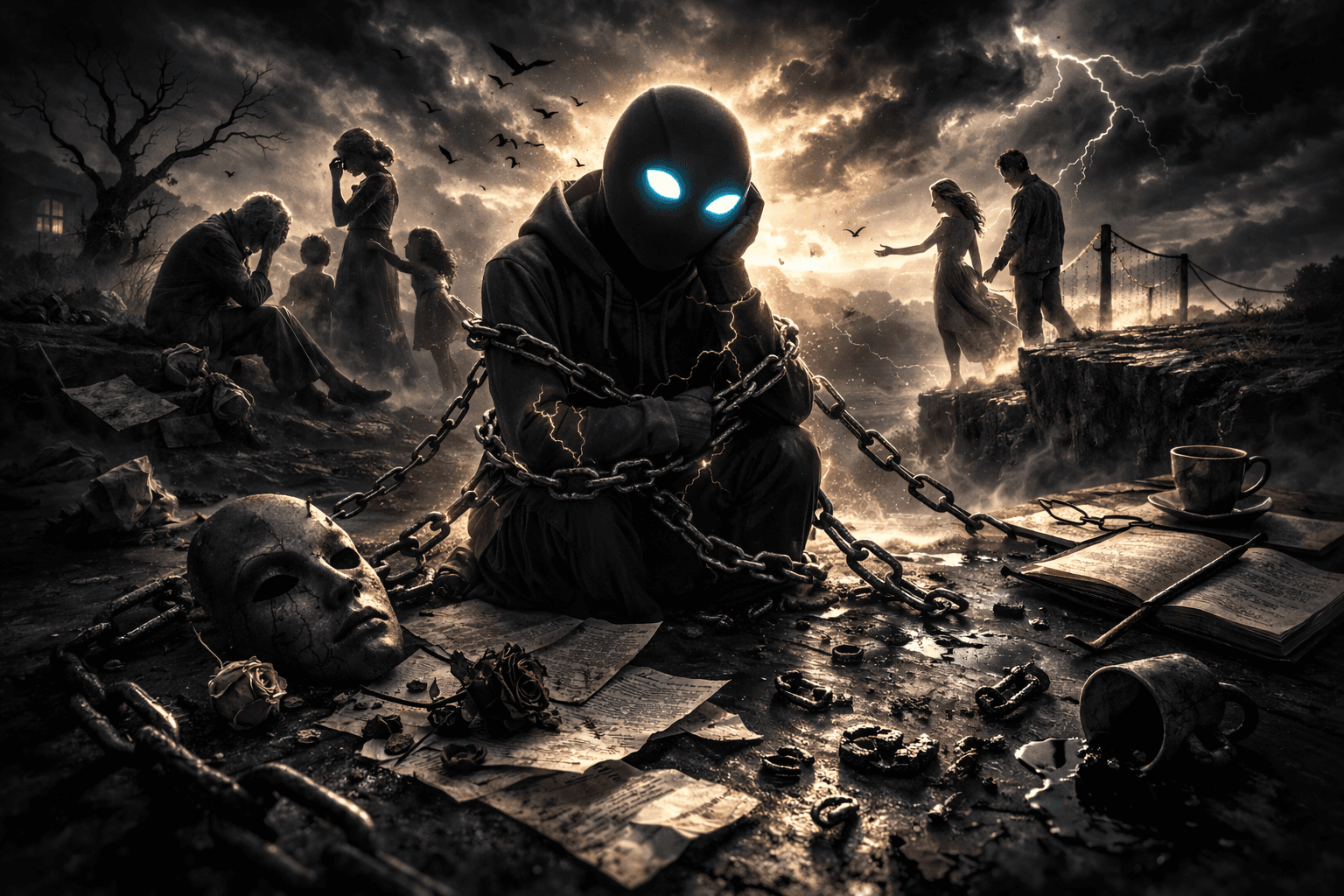
The Hidden Cost of Being the “Strong One”
Strength can become a prison when vulnerability feels unsafe.
In many families, friend groups, and relationships, there is one person known as “the strong one.” The dependable one. The calm one. The emotional anchor.
They are the person others lean on when life falls apart.
But strength that is born from necessity carries a hidden cost.
What begins as resilience can quietly turn into emotional suppression, hyper-independence, and eventually, exhaustion that no amount of sleep can repair.
This is the psychology of the “strong one”, and why the role often becomes a trap.
The Pedestal That Becomes a Cage
Being labelled “strong” sounds like praise. And for a time, it feels like it.
“You’re so strong.”
“I don’t know how you handle it.”
“We rely on you.”
These words reinforce the identity. But over time, the pedestal becomes a cage.
When someone is consistently cast as the resilient one, people stop asking if they are okay. Their emotional needs fade into the background. They become the advice-giver, the stabiliser, the problem-solver.
The quiet consequence is this: their own struggles become invisible.
This invisibility breeds a specific kind of loneliness, being surrounded by people yet feeling unseen. The strong one becomes skilled at holding everything together while slowly coming apart internally.
Parentification: Where the Pattern Begins
For many, the blueprint is drawn in childhood.
A concept known in psychology as parentification describes a role reversal where a child takes on adult responsibilities prematurely. This can happen when:
- A parent is emotionally unavailable
- A sibling needs protection
- The household is unstable or crisis-driven
The child steps up, sometimes explicitly asked, sometimes not, and becomes the emotional anchor.
Parentification teaches powerful lessons:
- My needs are a burden.
- Vulnerability is unsafe.
- Stability must be maintained at all costs.
The child becomes hyper-aware of others’ emotional states. They learn to regulate the room before learning to regulate themselves.
This is not natural resilience. It is a survival mechanism.
And survival mechanisms rarely dissolve on their own.
Emotional Suppression and the Nervous System
Over time, being “the strong one” requires emotional suppression.
Emotional suppression is the deliberate pushing down of feelings to maintain composure. It does not erase emotion — it stores it.
Research in psychology consistently links chronic emotional suppression with:
- Increased anxiety
- Burnout
- Emotional numbness
- Reduced relationship satisfaction
The nervous system remains in a low-grade state of stress. Even in calm environments, the body remains vigilant.
The person appears stable. Internally, they are managing constant tension.
The strong one does not collapse, they function.
But functioning is not the same as living.
Hyper-Independence: The Adult Adaptation
As this pattern moves into adulthood, it often evolves into hyper-independence trauma.
Hyper-independence is not healthy self-reliance. It is a rigid insistence on doing everything alone to avoid disappointment or vulnerability.
Common signs include:
- Reluctance to ask for help
- Difficulty delegating
- Perfectionism driven by control
- Discomfort with emotional dependence
In friendships, the strong one becomes the designated listener. In romantic relationships, they may struggle with true intimacy because vulnerability feels unsafe.
A partner may feel that there is always a subtle wall present.
The person has become so skilled at not needing anyone that they unintentionally make it difficult for anyone to truly reach them.
The Physical and Relational Toll
The cost of emotional suppression and hyper-independence is not purely psychological.
Chronic stress affects the body.
Studies have linked long-term emotional suppression to higher rates of cardiovascular strain, digestive issues, headaches, and systemic inflammation. When the nervous system remains in a defensive posture for years, the body carries that burden.
Relationally, suppression creates distance.
Research shows that individuals who habitually suppress emotion report:
- Lower perceived closeness
- Reduced social support
- Increased relational tension
Ironically, the strategy meant to protect against abandonment can create isolation.
The strong one becomes indispensable, yet emotionally distant.
The Breaking Point
For many, there comes a moment when the system fails.
It may be triggered by:
- A major life event
- Relationship breakdown
- Burnout
- A health scare
Or it may simply be the accumulation of years of quiet strain.
The collapse is terrifying.
When identity has been built around reliability and composure, losing control feels like losing the self.
There is often shame attached to this moment. The strong one believes they should be able to handle it.
But what is breaking is not the person.
It is the strategy.
Redefining Strength
True strength is not the absence of vulnerability.
It is the capacity to hold vulnerability without collapse.
Redefining strength begins with small, controlled acts:
- Answering “How are you?” honestly.
- Allowing help without immediate deflection.
- Communicating one's needs clearly and calmly.
Receiving support can feel unnatural at first. For someone accustomed to giving, receiving requires retraining the nervous system.
But strength built on isolation is brittle.
Strength built on interdependence is resilient.
The strong one does not need to abandon their resilience. They need to loosen the belief that strength means being alone.
Recognising the Pattern
Awareness is the first disruption.
If this pattern resonates, it may reflect a broader trauma response dynamic — often linked to parentification, emotional suppression, or hyper-independence coping strategies.
Understanding the mechanism reduces shame. It reframes exhaustion not as weakness, but as the cost of an overextended identity.
The identity of “the strong one” was built for protection.
But protection can harden into confinement.
Letting go of the role does not mean becoming fragile. It means allowing complexity — strength and softness coexisting.
True resilience includes the courage to be supported.
If you recognise yourself in this pattern, you may want to explore your broader psychological profile through the Trait Index — a short personality-style assessment designed to uncover hidden coping strategies and trauma response patterns.
Because strength is not about holding everything together.
It is about knowing when to let yourself be held.
Prefer to watch?
Related Case Files
Other patterns that connect to this topic.
The Trait Index
Discover which psychological pattern runs deepest in you. 12 questions. 6 archetypes.
Take the Trait IndexStay in the loop
New case files, psychological deep dives, and pattern breakdowns delivered to your inbox.